The most acute water crises occur in everyday contexts in impoverished rural and urban areas across the Global South. While they rarely make headlines, these crises, characterized by inequitable access to sufficient and clean water, affect over one billion people globally. What is less known, though, is that millions of these same global citizens are at the forefront of responding to the challenges of water privatization, climate change, deforestation, mega-hydraulic projects, and other threats to accessing water as a critical resource.
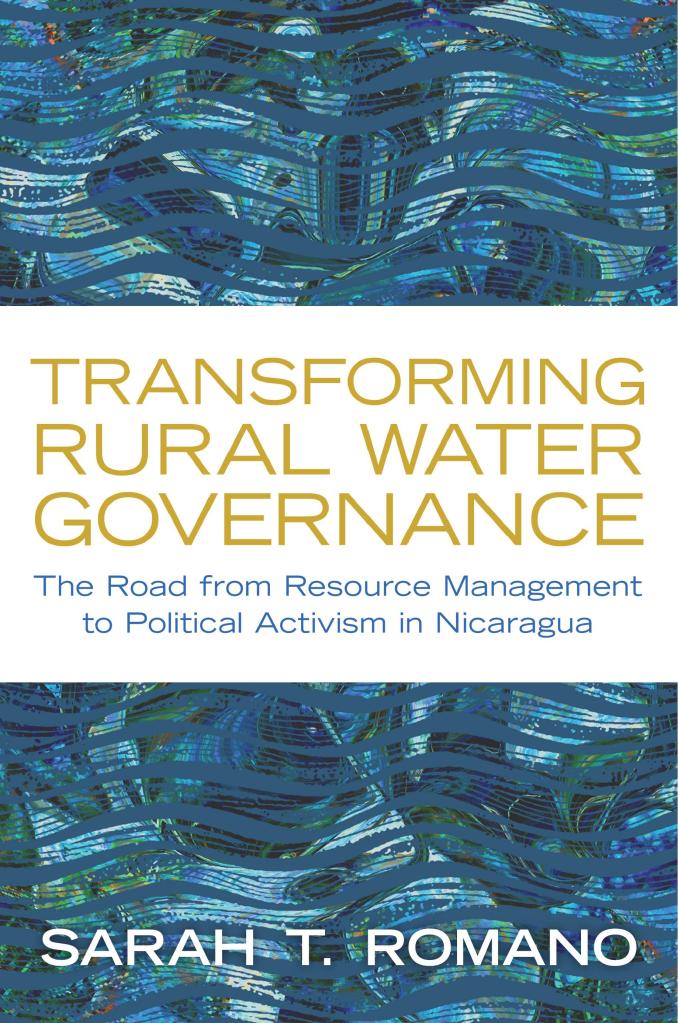
Transforming Rural Water Governance explains the bottom-up development and political impact of community-based water and sanitation committees (CAPS) in Nicaragua, tracing the evolution of CAPS from rural resource management associations into a national political force through grassroots organizing and strategic alliances.
BOOK REVIEWS
“Sarah T. Romano’s Transforming Rural Water Governance is one of the most unique contributions to the literature on the politics of water. Romano masterfully blends scholarship on the global and the local by examining Nicaragua – one of the least studied countries around the world. […] Romano takes a topic that requires understanding of social movements theory, transnational environmental activism scholarship, and commons governance studies to develop a framework that brings forth our understanding of how traditionally disempowered grassroots groups become politically powerful, all the while contributing to the robust governance of a scarce resource.”
Raul Pacheco-Vega, Center for Economic Teaching and Research (CIDE), Mexico
“Romano’s Transforming Rural Water Governance is a must-read for scholars, policy makers, conservation practitioners, and broader audiences who are interested in the theory and practice of collective action for political mobilization and grassroots natural resource management, particularly within the contexts of ongoing social and environmental change. It is an easily digestible and effectively organized book for novices and experts alike.”
Michael A. Petriello, Dalhousie University

“Sarah Romano’s book…is an excellent case study of successful collective action and mobilization in the rural water sector, following in the influential traditions of Elinor Ostrom and Judith Tendler. Romano contributes to literatures about common property regimes, social capital, and decentralization, and her research advances our understanding of the role of grassroots organizations in “multiscalar” political activism that spans communities, sectors, and levels of government.”
Alicia Dailey Cooperman, Texas A&M University
“Sarah Romano’s book…provides an acute analysis of the development, organization, and outcomes of community-based water and sanitation committees in Nicaragua spanning the whole of the twentieth century, with a heavy focus on the last twenty years of that century. […] For environmental historians, this book offers insight into the important ways in which water can be governed and how people have fought to ensure that access to water remains in the public sector.”
Emily Wakild, Boise State University
“Transforming Rural Water Governance is a book about daily life, about rural communities’ resilience, about protecting basic natural resources from [the] bottom up. It is also a book about the importance of the rural world in the provision of basic services to urban territories. And about how, even with limited resources but with the conviction of protecting their lives and territories, Nicaraguan community-based water management regimes found a way to be legally recognized by the state, while at the same time keeping up their independence. Moreover, it is a book about how, through grassroots activism and collaboration, it is possible to influence public policies and to “not only create more inclusive governance but also the potential for a greater social and environmental justice.”
Sandra Guttierez Poizat, Universidad Centroamericana José Simeón Cañas (UCA)
Link to review in Water Alternatives
ENDORSEMENTS
“Drawing on extensive fieldwork, Romano writes with compelling detail to reveal how Nicaragua’s rural water committees have achieved legitimacy, national presence, and ongoing influence even as they continue to confront challenges. This insightful and highly readable book will be useful for anyone interested in water governance, collective action, and social movements.”
Catherine M. Tucker, author of Changing Forests: Collective Action, Common Property, and Coffee in Honduras
“Transforming Rural Water Governance addresses the importance of local activism in response to a changing climate and incorporating a new perspective of environmental justice in Nicaragua, where access to clean water plays a much more intrusive role in the minds of its citizens.”
Morgan S. Abbott in Economic Botony
“An important contribution to the literature on common resource management and the politics of rural water governance. Romano’s focus on water providers that operate ‘below the radar’ of public policy-making is especially important in the water sector, a sector with low state capacity in the region.”
Madeline Baer, author of Stemming the Tide: Human Rights and Water Policy in a Neoliberal World
 Sarah T. Romano, PhD